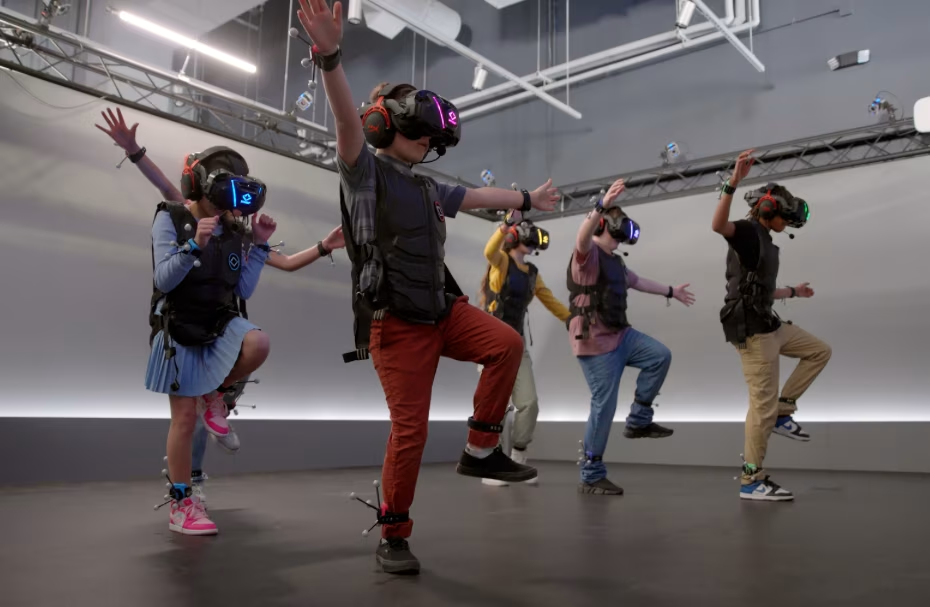
VR motion tracking uses full-body sensors to mirror real movements in VR, creating immersive, responsive experiences that truly feel real.

VR Motion Tracking: How Full-Body Tracking Makes VR Feel Real
VR motion tracking is responsible for some giant leaps forward in the realism and comfort that can now be achieved with virtual reality experiences. This technology is a major reason for the viability of the Sandbox VR concept, bringing high-quality, realistic VR to the casual user. How does it work? Here's a quick, non-technical primer on VR motion tracking, the tech that makes virtual worlds seem real.
Table of Contents
What Is VR Motion Tracking And Why Does It Matter?
How Do VR Tracking Systems Capture Full-Body Movement?
What Is Full Body Tracking In Virtual Reality?
How Does VR Motion Tracking Make Virtual Worlds Feel Real?
Why Is VR Motion Tracking Essential For Social VR Experiences?
How Does Sandbox VR Use Motion Tracking Differently?
What’s Next For VR Motion Tracking Technology?
What Is VR Motion Tracking And Why Does It Matter?
VR motion tracking is a technology for capturing and digitizing an individual's physical movements, generally for the purpose of mapping them to a 3D virtual environment.
This is typically done through the interaction of sensors. Users will wear sensors, often embedded in headsets, gloves, and ankle attachments. They are then put into a room that may also be equipped with sensors (or not - more on that later). The sensors read your movement in a defined area, creating a detailed digital map of the user's position in the room and their movements. These movements are then mapped into a 3D digital environment in real-time, with that information relayed back to the user's headset display.
In this way, you see yourself in a virtual world, moving exactly as you feel yourself moving in reality, with the same field of vision you experience in reality. You can move your hand in front of your face or use it to interact with objects in the virtual world.
Accurate motion tracking creates a sense of realism, presence, and comfort in a virtual world that is essential for the experience to be considered realistic. The overall tracking quality directly impacts performance, when tracking is precise and responsive, movements feel seamless.
VR motion tracking is sometimes also referred to as a VR tracking system or full-body tracking, more or less synonymous terms. "Motion capture VR" also refers to motion tracking VR, but it is a different technology. Motion capture is more of a recording technology, used for animation, not interactive VR.
How Motion Tracking Creates a Sense of Presence
With VR motion tracking, you can see your own body move naturally in a virtual environment. Take a step, you take a virtual step. Jump, duck, or swerve, our virtual avatar's movements precisely match your real-life movements. This mirroring of actual and virtual movement contributes to "presence", the sense that you are immersed in the virtual world.
For the brain, this is much more convincing than mere high-resolution visuals. If you're wearing a VR headset and sitting down, you are aware that you're sitting down, no matter how beautiful the visuals are showing your character running through a virtual landscape. But if you are standing up, moving around, and your virtual avatar is doing everything you know that you're doing with your body, you instantly feel more connected to the virtual experience.
How Do VR Tracking Systems Capture Full-Body Movement?
Very simply, modern virtual reality tracking systems gather movement data from multiple data points. Typically, these data points are sensors that track movement in the head, hands, torso, and feet. These trackers are combined with advanced software that interprets movement data in real time. With this information, the sensors can effectively create a 3D image of your body, moving in real time.

Sensors, Cameras, and Spatial Awareness
Two broad categories of sensor technology can be used for VR tracking systems: Inside-out tracking and external or outside-in tracking.
Inside-out tracking refers to a system that relies on sensors and cameras mounted on the user's body. For example, cameras on a headset scan a room to understand positioning relative to the surrounding space.
Outside-in tracking relies on external sensors around the room that interact with sensors on the user's body, building a 3D image of the user's movement through the mutual interaction of the sensors.
Generally, inside-out tracking is associated with a high degree of portability, while outside-in tracking is considered more accurate.
Most modern tracking systems use "6DoF" movement tracking: Six degrees of freedom. The six degrees are broadly rotation and translation, or what you might consider "side-to-side" and "front-to-back" movements in space.
Overall, these tracking systems create highly detailed images of depth, position, and orientation, which allows for real-time spatial tracking. High-end systems are also designed to minimize drift, preserving tracking functionality and keeping physical and virtual positions perfectly synced. This, in turn, facilitates real-time movement in the virtual world, reducing lag and the discomfort and disorientation that users can experience when their virtual and physical movements are not aligned.
What Is Full Body Tracking In Virtual Reality?
VR full-body tracking is exactly what it sounds like: head-to-toe motion tracking. This facilitates the creation of a full-body virtual avatar that moves in the virtual world exactly as you move in the real world. By tracking arms, legs, and posture, not only head or hands, you can experience natural, real-time movements in the virtual world. You walk, your avatar walks; you duck, your avatar ducks. A true full-body tracking experience doesn't just show where you are; it captures how you move, giving your avatar weight, posture, and intention.
This is distinguished from other tracking methods. For example, hand-only VR is a useful tool for experiencing controller-free games (the movements of your hands in space are detected instead), but it doesn't deliver the precise spatial tracking of a full-body system.
From Motion Capture VR to Real-Time Interaction
There are three basic categories of virtual reality: Non-immersive, semi-immersive, and fully-immersive.
Simplistically, we can think of the evolution of VR technology as moving along the spectrum from non-immersive to fully-immersive. Traditionally, increasingly high-quality animation could be derived from motion capture, producing digital images that appeared real on screen, but which we knew were just features of a movie: Non-immersive.
Taking the principles of motion capture and applying them to real-time movements is a step forward. Expanding those movements from hand or head gestures to full-body avatars is the final step into fully-immersive VR.
How Does VR Motion Tracking Make Virtual Worlds Feel Real?
Once you can mirror your real-world movements in a virtual environment, you achieve a level of immersion in the virtual world that simply isn't possible when you're sitting down with a headset.
Physical actions create emotional responses. Ducking and swerving feels real because it is real; you are actually doing these things.
This creates stronger memories: You have experienced the virtual world and effectively lived in it, rather than just watched it happen around you.
Body Awareness and Environmental Interaction
The feeling of immersive reality is built on the same cues and reactions we experience in real life. We see our body interact with objects in the virtual world just as we do in reality. A realistic sense of touch, proximity, and accurate spatial cues mean we are functioning in the virtual space almost exactly as in the real world. This makes virtual environments feel responsive to our presence and actions, just as in reality.
Why Is VR Motion Tracking Essential For Social VR Experiences?

VR motion tracking doesn't just make the world seem more realistic because of your movements. It also makes your teammates' movements appear realistic. Social VR experiences are more powerful than individual ones because we get to see other people reacting to the same environment, enhancing a sense of the reality of the surrounding world.
With motion-tracking-enabled full-body avatars, you can communicate with your friends with the full range of non-verbal communications you're used to using in real life.
All of this facilitates collaboration in the virtual world, building excitement through shared experiences.
Shared Movement Creates Shared Moments
Sandbox VR was quick to understand the power of shared experiences in VR, leaning into creating VR experiences that are optimized for groups of up to six people. Thanks to motion tracking, teams can make eye contact, point, and react together to what's happening around them. All of this shared movement creates shared moments, immersive moments that feel cinematic rather than isolated.
How Does Sandbox VR Use Motion Tracking Differently?
The Sandbox VR approach to motion tracking integrates full-body motion tracking and haptic feedback (a sense of touch) to develop a virtual avatar that is fully immersed in its world. This is further enhanced by creating story-driven experiences that use cinematic narrative techniques to draw you into the virtual world.
Designed for Immersion, Not Just Technology
At Sandbox VR, technology is in service of the experience. From zombie survival scenarios to epic sci-fi adventures, every Sandbox VR experience is designed to ensure that the realism of your physical movement drives narrative movements. As quickly as possible, we want you to forget that you're in a VR facility and be totally focused on the world unfolding before you.
What’s Next For VR Motion Tracking Technology?
As the technology continues to improve, look for improvements in sensor accuracy and responsiveness to drive greater realism in movement and interaction. This anticipated evolution of VR motion tracking will allow us to create even more immersive stories set in even more convincing virtual environments.
The Future of Fully Embodied Virtual Reality
The bottom line is that more natural movement leads to deeper emotional engagement with the virtual world. We look forward to a future where there is a seamless blend of physical and virtual spaces, making for a heightened VR experience.
VR motion tracking is an essential technology in delivering immersive VR experiences. Discover just how close to reality a virtual world can be at Sandbox VR and book an experience today.
FAQs
Is VR motion tracking required for immersive VR experiences?
If you want truly immersive VR experiences, yes, accurate motion tracking is essential. It is the basis of realistic interaction and presence, allowing you to feel thoroughly embedded in the virtual world.
Does full-body tracking make VR more comfortable?
Yes, because natural movement alignment can help to reduce disorientation for many users. If you can see and experience your body moving in the virtual world as you do in the real world, the whole VR experience feels more natural and comfortable (as comfortable as you can be when battling a zombie horde).
Is motion capture VR the same as VR motion tracking?
The two terms are often used interchangeably, but they are quite separate technologies. In simple terms, motion capture records movement, which is used for high-quality animation, for example. Motion tracking is more about monitoring how objects are positioned and moving, allowing them to be mapped into a 2D or 3D environment, and this can be manipulated to produce real-time interaction between an individual and a virtual environment.
Can multiple people be tracked at once in VR?
Yes, advanced VR tracking systems routinely follow multiple users through a common virtual space.
Is full-body VR tracking a fairly advanced technology?
It is an advanced technology that is constantly improving. Full-body VR relies on a sophisticated interplay between sensors and real-time data processing, only becoming feasible for widespread consumer-grade applications within the last decade.
Other Articles

Comparing the Best Sandbox VR Games
Compare every Sandbox VR experience by genre, age, and group size to find the right VR experience for you and your crew.

Gaming Room Guide: What You Need To Know
Gaming rooms are evolving, discover how immersive gaming rooms work, what to expect, and why Sandbox VR delivers the ultimate experience.