Inverse kinematics brings realism to VR. Discover how Sandbox VR uses it to create lifelike motion and physical sensations in virtual experiences.

How Inverse Kinematics Provides Physical Sensations in a Virtual World
Virtual reality is closing the gap between physical and digital worlds, but making movement feel real takes more than just visuals. The key lies in how technology interprets every limb, twist, and turn to match what you do in real life. At the heart of that translation is inverse kinematics, the hidden math behind true immersion and one of the core methods used to find solutions that keep your avatar aligned with your real-world position.
Table of Contents
What Is Inverse Kinematics And Why Does It Matter In Virtual Reality?
How Does Inverse Kinematics Work Behind The Scenes?
What Role Does Forward Kinematics Play In VR Movement?
How Does Sandbox VR Use Inverse Kinematics To Create Physical Sensations?
How Does Inverse Kinematics Enhance Group VR Experiences?
What Are The Technical Challenges Of Implementing Inverse Kinematics In VR?
What’s Next For Inverse Kinematics In Virtual Reality?
How Do Inverse Kinematics And Haptics Work Together?
Bringing Real Bodies Into Virtual Worlds
Conclusion / Summary, TL;DR
FAQs
What Is Inverse Kinematics And Why Does It Matter In Virtual Reality?
Inverse kinematics (IK) is the technology that lets your digital body mirror your moves. It calculates the exact joint angles that it needs to achieve, so your avatar's limbs are in the desired or target location. For example, if your virtual hand needs to reach a wall or aim at an object, the IK system figures out how your shoulder, elbow, and wrist must rotate to do that. This IK process acts as a core function in determining how every joint shifts into the correct position.
Forward kinematics (FK) goes the other way: starting with defined joint angles to see where the end effector (like your hand) will be. This may not seem much different, but in virtual reality, that distinction is significant.
Without inverse kinematics, avatars might look awkward or fail to match your body. With it, each movement syncs naturally between real and digital space. For example, Sandbox VR's advanced IK analyzes and replicates your every motion, giving your avatar a lifelike posture and responsiveness. When you wave, crouch, or sidestep, the system can ensure your digital representation follows instantly and accurately.
How Does Inverse Kinematics Work Behind The Scenes?
This seamless motion relies heavily on mathematics and physics. Inverse kinematics models the human body as a hierarchical chain. The torso connects to the upper arm, the upper arm to the forearm, the forearm to the wrist, and so on. When one joint rotates, that affects the next segment down the line. The relationships among these joints are defined through kinematics equations that describe movement limits, rotational axes, and position vectors.
The main goal is to find a set of joint angles that move the end effector to a desired position. Simple, two‑joint systems can often be solved directly, using clear mathematical relationships. But for full‑body systems with multiple joints, these clean answers rarely exist. Instead, you have to use numerical methods, conducting iterative processes that adjust each joint angle in the line until the virtual limb matches the target location as closely as possible.
IK gets even more complicated when you consider that there are multiple solutions to each problem. For example, your hand could reach the same point with a straight or bent arm. So the software has to pick the most human‑looking solution, defined by smooth motion and biomechanical plausibility. For instance, Sandbox VR’s motion engine applies continuous evaluation to find stable, natural configurations that adapt in real time.
Processing all of this while maintaining frame speed is complex. Many systems gather live tracking data from numerous sensors, feeding it all into their solver hundreds of times per second. The system constantly recalibrates, ensuring your avatar’s movement matches not only your physical action but also the environment’s constraints. Each recalculation corrects tiny mismatches, making every gesture feel grounded and consistent.
Think of this like controlling a robotic arm. You specify where the hand at the end should go, but then the system has to compute how each joint contributes to reaching that destination without breaking any physical limits.
What Role Does Forward Kinematics Play In VR Movement?
Forward kinematics predicts motion when you already know all the joint angles. For example, if you set the rotation at your shoulder and elbow, FK determines where your hand will appear. It’s direct, predictable, and essential for standard animations.
In virtual environments, FK generally handles the base skeletal structure. When you calibrate your avatar in a VR session, FK maps your body’s general framework to get a starting point from which it can use IK to dynamically adjust and refine every pose.
This combination matters because real motion is layered. FK defines your default posture and rhythm, while IK ensures exact hand placement and spatial accuracy. Together, they create physically believable movement that responds smoothly to every change in direction or action, which is crucial to maintain immersion in full‑body VR environments.
How Does Sandbox VR Use Inverse Kinematics To Create Physical Sensations?
Sandbox VR builds its sense of presence around IK. IK creates “embodiment,” the cognitive link between your real body and your avatar’s body. That link lets you feel like your virtual arms and legs belong to you, rather than a separate character.
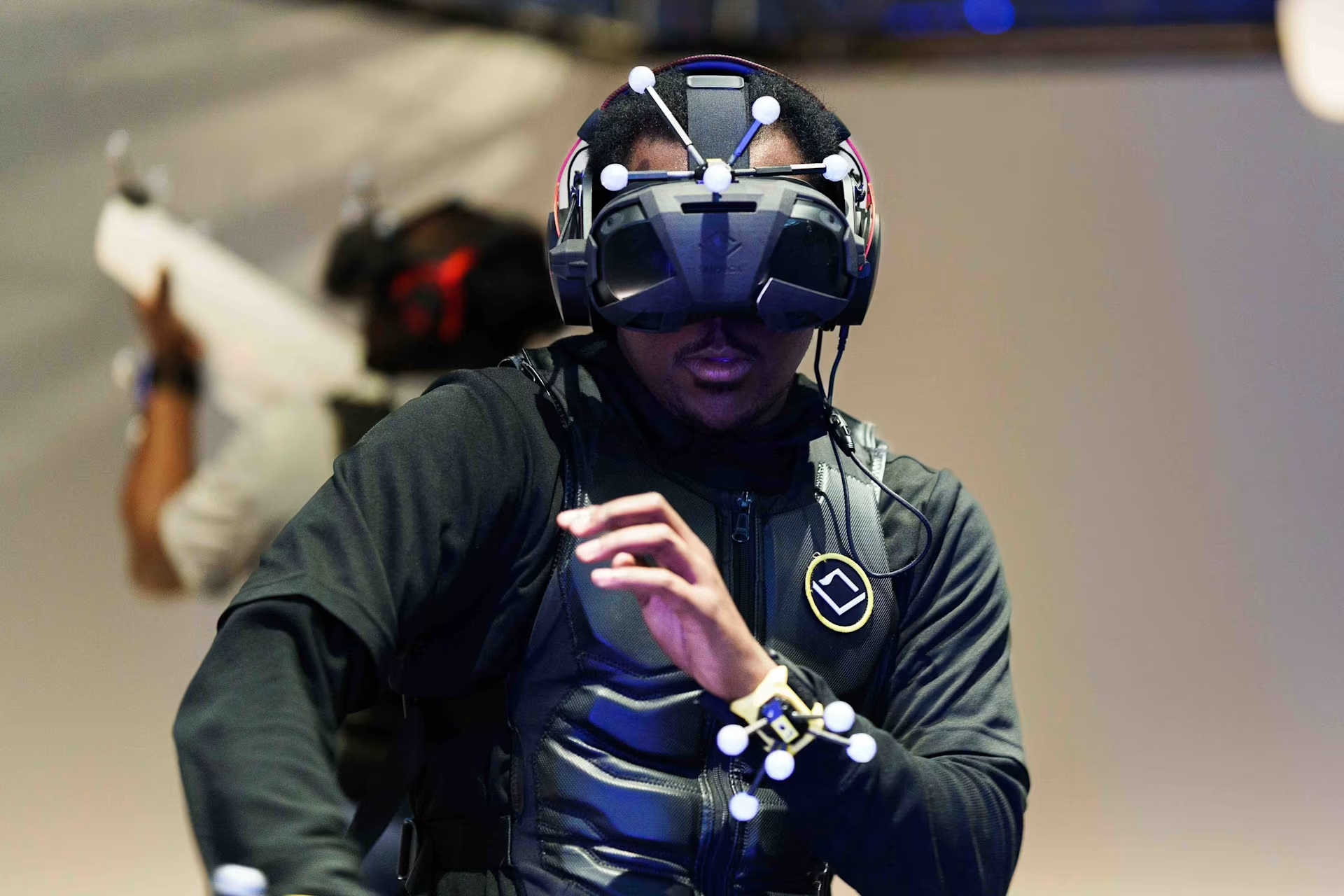
When you reach for something in a Sandbox VR experience, IK calculates the path for each joint and applies it instantly to your avatar. Your tracked limbs feed data into the solver and, in moments, the virtual figure duplicates your motion with high fidelity. The system records and replicates even small gestures, like twisting your wrist or tilting your head, to maintain consistency.
The spatial accuracy enables your physical interactions. Sandbox VR integrates precise IK mapping so that actions like shaking hands or passing an object work seamlessly between players. This harmony of physical intent and digital execution turns social VR into something tactile.
Full‑body motion capture data fuels this process. The collected positions and rotations are converted into joint angles and end‑effector adjustments in real-time. When IK detects contact points, Sandbox VR’s haptic systems engage instantly. A slight vibration signals that you’ve caught an object, or a brief pulse tells you that you’ve touched another player’s hand. These tactile sensory confirmations strengthen your immersion by making your virtual contact feel real.
The synergy between IK and haptics makes each Sandbox VR session feel more physical, grounded, and convincing.
How Does Inverse Kinematics Enhance Group VR Experiences?
Group immersion is where inverse kinematics truly shines. In Sandbox VR’s multi‑user setups, IK ensures that each participant’s virtual body faithfully reflects their real movements. You see each teammate’s gestures, posture, and expressions in real time, enabling communication through motion instead of just words.
This accurate body representation transforms teamwork and interaction in a few ways:
Cooperative missions can rely on synchronized actions, like lifts or coordinated efforts.
Puzzle solving becomes natural when you can use meaningful gestures, such as pointing, signaling, or sharing focus.
Micro‑movements, such as nods or shrugs, become authentic communication tools.
Without precise IK, these details vanish, breaking engagement. Sandbox VR solves this through group calibration and joint‑mapping consistency, allowing every player to exist within the same spatial reality. The system interprets relative positions, identifies overlaps, and prevents collisions between digital bodies, maintaining believable group dynamics.
This natural realism makes teamwork more fun. Seeing each other move smoothly, within millimeters of real‑world accuracy, helps build a genuine presence in your shared virtual space.
What Are The Technical Challenges Of Implementing Inverse Kinematics In VR?
Running inverse kinematics at scale poses many challenges. Each body has 30 or more active joints, which all must be updated dozens of times per frame. Multiply that by the number of participants, and the complexity compounds quickly.
You first have the challenge of computation time. Solving IK equations fast enough for real‑time responses pushes many systems' limits. Sandbox VR uses optimized algorithms that balance efficiency with fidelity to keep virtual limbs locked to real movement with minimal delay.
Next is the “multiple solutions” dilemma. When many joint configurations can achieve the same result, the system must select one that appears both stable and human. Some systems try to address this by using parameter weighting derived from biomechanical data, favoring postures that mirror natural human constraints.
Tracking interference adds another layer of difficulty. When sensors lose track of a joint (like when your arm moves behind your torso), the solver must predict its motion until it can detect that joint again. Sandbox VR addresses this with predictive modeling. The system fills those data gaps using prior frame trends and recorded ranges of motion.
What’s Next For Inverse Kinematics In Virtual Reality?
As technology evolves, artificial intelligence (AI) and enhanced sensors are redefining inverse kinematics. Machine‑learning (ML) IK systems analyze huge libraries of motion data to predict natural transitions instantly. Instead of calculating every movement from scratch, they learn what authentic motion looks like, saving a lot of processing power.
AI‑powered IK detects subtle cues, such as where balance shifts or how momentum carries a limb, and adapts the solution accordingly. This produces lifelike, flowing avatars that behave like their human counterparts even in rapid motion.
Future advancements include neural IK solvers that operate via adaptive pathways inspired by brain activity. They read minimal input data to infer full‑body poses instantly. Combined with improved tracking wearables, this could shrink setup complexity while improving precision.
Haptics will also continue to evolve. As IK defines end‑effector collisions with pinpoint accuracy, tactile systems can deliver richer physical textures, like real resistance or weight simulation.
Together, these burgeoning technologies will produce a more personalized virtual embodiment, where every subtle movement, breathing, balance, or expression translates faithfully into the digital form.
How Do Inverse Kinematics And Haptics Work Together?
Motion feels hollow without a sense of touch. Inverse kinematics and haptics close that gap by matching up visible contact with tactile feedback.
When your virtual hand meets an object, IK records the exact collision point. A signal then travels to haptic devices that produce corresponding sensations, such as a pulse, buzz, or short burst of resistance. The sync must be nearly instantaneous, because even a fraction of a second delay can disrupt realism.
Sandbox VR’s coordination system ties these effects tightly:
Grasping virtual items creates localized vibration that matches grip pressure.
High‑fiving a teammate sends simultaneous tactile feedback to both players.
Opening a heavy virtual door triggers resistance and motion‑based vibration tuned by IK calculations.
This interplay of sensory timing transforms gestures into genuine physical events. The combination of accurate motion mapping and physical response creates a cohesive illusion where your body and avatar act as one.
Bringing Real Bodies Into Virtual Worlds
IK connects digital simulation to human motion. Instead of controlling an on‑screen model, you inhabit it. This sense of embodiment breaks the barrier between real and virtual.
Sandbox VR leads this transformation by merging IK, precise motion tracking, and haptic technology into one system. The platform provides shared experiences that feel intuitive because movement itself becomes communication. Each gesture carries emotional weight and physical credibility.
This approach turns virtual reality into a medium of presence rather than performance. It becomes a space where bodies replace controllers and movement becomes the interface.
As IK and sensory tech continue to evolve, the boundary between person and avatar will further fade. Sandbox VR’s research points toward a future where the virtual self is not a representation but an extension of who you are.
Inverse Kinematics Enables VR
Inverse kinematics translates physical movement into authentic digital embodiments. It calculates joint angles, aligns motion with avatars, and connects sensors to sensations that feel real. Sandbox VR perfects this with advanced tracking, predictive modeling, and synchronized haptics, creating unmatched realism and shared immersion.
Book an experience to see how mathematics and human motion blend into a living, responsive virtual world.
FAQs
Here are the answers to some of your most pressing questions about IK:
Is inverse kinematics used in all VR experiences?
Most modern immersive VR platforms use inverse kinematics to make avatar movement realistic and grounded.
Can inverse kinematics make you feel things in VR?
Yes, indirectly. IK creates motion precision that alerts haptic devices when physical responses are required. Haptic devices produce the physical sensations that complete the illusion.
What’s the difference between inverse and forward kinematics?
Forward kinematics moves joints to see where a limb ends, while inverse kinematics starts with a target position and calculates joint angles backward.
Does inverse kinematics improve multiplayer VR?
Yes, it lets multiple players interact with natural gestures, body language, and synchronized actions in real time.
Is inverse kinematics the future of VR realism?
Yes, it’s central to creating immersive environments where digital motion feels identical to real movement, paving the way for true embodiment.
Other Articles
Immersive Storytelling In VR
Immersive storytelling in VR transforms gameplay, pulling players into fully interactive worlds for unforgettable Sandbox VR experiences.

Dynamic Gameplay Experience Guide
Dynamic gameplay experience explained in a clear, simple way. Learn how DGE videos work and how they elevate every Sandbox VR adventure.
